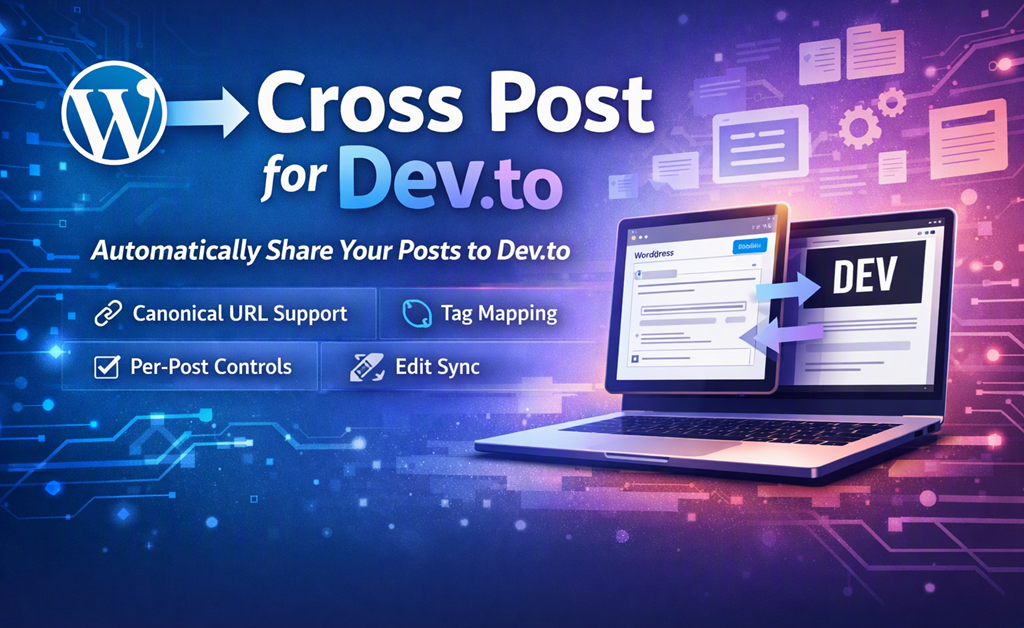
I’ve released Cross Post for Dev.to, a WordPress plugin that mirrors a post to Dev.to the moment you publish it on your own site. The plugin itself is simple: one hook, one API call, one published mirror. The interesting part of this release isn’t the feature. It’s what had to be true for a zero-dependency plugin to stay trustworthy over time without me babysitting it.
The problem
Most small WordPress plugins rot over time. They’re built against whatever WordPress version happens to be current, they lean on a third-party library or two to save time, and neither the plugin nor the library gets revisited until something breaks. Usually a major WordPress release, sometimes a PHP version bump. At that point the maintainer generally abandons the project and so many of these lesser used plugins become useless for users.
Cross-Post for Dev.to needed to cross-post reliably from WordPress to Dev.to without letting that happen so easily. No bundled third-party SDKs, no external service sitting between the plugin and the Dev.to API, no dependency that could go unmaintained while the plugin using it kept shipping.
Why zero-dependency isn’t the whole answer
Removing dependencies fixes one kind of rot but not the other. A plugin with no third-party packages can still quietly break against a new WordPress release; deprecated hooks, changed REST behaviour, PHP version drift. Zero dependencies means less that can fail underneath you; it says nothing about whether the plugin still works today. Those are two different guarantees, and conflating them is how “lightweight” plugins end up just as unmaintained as heavy ones, only with fewer visible warning signs.
So the actual problem wasn’t “avoid dependencies.” It was “know, continuously and automatically, whether this plugin still works”. Which is a validation problem, not a packaging problem.